Thursday, February 24, 2011

Panama!

We crossed the Costa Rica/Panama border during daylight and we knew it because there was a very clear landmark: deforestation. The lush rainforest in Costa Rica ended abruptly at the Panama border, leaving no question about where we were. We kept sailing and arrived in Panama City during the night. The lights across the skyline suggested that Panama City was huge, stretching across the length the northern shore of the bay of Panama.

For some reason I was particularly awake that night so I told John to go back to sleep when he came to relieve me of my watch. I turned up my iPod and held my own private midnight dance party on deck, pausing in between songs to examine our surroundings with the binoculars and look for navigational beacons. I was scanning the horizon when I noticed that the lights of the city were clumped together in neat bundles, with distinct lines of black unlit skyline separating them. These lights weren’t those of Panama City, they were ships! Hundreds of ships gathered near the shore, waiting their turn to transit the canal.

A few hours later it was all hands on deck as we navigated through the shipping anchorage. Massive tankers with their decks lit up loomed above us like sleeping giants as we glided past them in the night. Over forty ships were crowded together on the screen of our AIS. Finally we slipped into the fuel dock at Isla Flamenco marina and went to bed around 3AM.

In the morning it became clear we were in the most developed country in Central America. This place was hustling and bustling. The marina was full of expensive powerboats, and workers were everywhere cleaning the boats, repairing them, or just lounging around on them blasting club music. In the daylight, the skyline of Panama City was impressive. It looked like Manhattan!

John’s parents, Vince and Margie, came down to visit and transit the canal with us. We met up with them at the coffee shop in the marina and Kitty and Margie fell in love. Later our day Tina, our agent, set us up with a driver to take us on a tour of the city. Our driver, Mario, took us to the Miraflores Lock in the Panama Canal so we could watch a ship going through.

Looking toward the Pacific from Miraflores Lock.


A ship coming south, from the Atlantic towards the Pacific.


Then we toured the French Quarter and saw the Palace of the President. It was a charming area of town, with interesting architecture that reminded me of the French Quarter in New Orleans.


To get to the French Quarter, however, we had to drive through the ghetto. It was quite dilapidated and seedy and apparently exceedingly dangerous. All taxi drivers we had while we were there told us to lock our doors and they drove like wildmen through the narrow streets, stopping for nothing and nobody. Mario, our driver, was a nice man who was a Seventh Day Adventist and told us all about what his life was like living in the ghetto. The drug dealers leave him alone because he is religious, and they call him “the pastor,” but he does his best to stay out of their business. His life depends on it.


Mario took his job as tour guide very seriously. He took us to his friend’s pizza restaurant for dinner. It was a family place with delicious Italian food and it was super cheap. Dinner for seven people came out to around $50. The only oddity about the place was that there was a security guard out front that we tipped as we left for ensuring us a safe dining experience.

Mario kept wanting to show us more and more of Panama City, even though it was getting later and later. He drove us around downtown, through the wealthy sections of town, and by the new Trump hotel whose architecture was inspired by sailboats. While the city skyline was impressive during the day, at night it was downright eerie. One would expect the buildings to be lit up like they are in US cities, but they were mostly dark. Some skyscrapers were completely unlit, indicating their vacancy, while others had lights on in only a small fraction of the rooms. When Mario insisted on finding us an ice cream shop even though we were nodding off in the car, we finally had to vehemently tell him to take us back to the marina as we were all exhausted.

We found ways to amuse ourselves while we waited for our canal transit date to be determined. One day I took a sojourn to Albrook mall and was blown away by its immensity. It was enormous! The biggest mall I’ve ever been in, bigger even the Mall of America in Minneapolis, I think. It was filled with people and everything was so cheap! After months of living on a boat in under-developed countries, the consumerism was an incredible culture shock. I spent about $20 and came home with a new boat wardrobe.

Finally we found out we’d be transiting the Panama Canal on February 14th, Valentine’s Day.

Tuesday, February 22, 2011

El Golfo Dulce

Our next stop was Bahia Ballena, a beautiful bay with a little fishing community on the east-facing side of the Nicoya Peninsula. We spent two nights at anchor there, enjoying the internet access and blended fruit drinks at the yacht club. John took the long board out and caught a few waves, even though it's not an ideal surf spot. After two nights at anchor we headed south for Quepos, where we hoped to clear out of the country.

Bird-covered tuna boat off the coast of Costa Rica.

We got to Marina Pez Vela in Quepos around 8PM and although we’d tried calling them by phone earlier in the day, and again by VHF as we approached, nobody had answered the phone or the radio. Two security guards met us at the fuel dock and told us we may not be able to stay in the marina because we didn’t have a reservation, even though the place was mostly empty. Twenty minutes of deliberation and phone calls to superiors – spoken in both Spanish and English – concluded with the definitive verdict that we had to leave the marina. It was dark out and had started to rain. This was the first time we encountered a situation like this and we’ve come into a number of marinas during the night or after marina office hours. The marina manager, Perry, was extremely rude, unhelpful, and condescending. It was a miserable experience. That night we headed straight for the Osa peninsula planning to check out of Costa Rica in Golfito. After such inhospitality in Quepos, we didn’t feel they deserved any of our business.

It was just as well because our experience in Golfito was wonderful. The Osa peninsula is the most untouched part of Costa Rica. Everywhere you look, the dense and verdant rainforest cascades over the hills to meet the emerald waters of the Golfo Dulce. From the boat we could hear the roar of the jungle: a vibrant medley of cicadas, birds and howler monkeys.

Cabo Matapalo

Golfito itself is a slightly run-down town shaped like a green bean that lies along the northern shore of the Gulfo Dulce. The marina consisted of a funky wooden house built on stilts over the water and a tiny dock with room for one big boat and a few dinghies to tie up. We left El Tiburon at anchor and dinghied over to the “yacht club.”

Marina in Golfito

The owners had about five dogs that Kitty made fast friends with. They all seemed to get along well except for a miniature pincher with a spiked collar named Vinny, who would emit a low rumbling sound whenever Kitty got too close to him. The atmosphere at Land Sea Marina was relaxed and friendly. Cruisers could help themselves to a book and a beverage and settle into one of the padded chairs in the outdoor living/dining room of the club, maybe with a dog at their feet or on their lap. The exchange library and beverage cooler were regulated by the honor system, and the temperature under the thatched roof was always perfect.

One night there was a potluck dinner party in the yacht club, and all six dogs were running around sniffing and begging for scraps of fish taco and bacon wrapped figs. Just as one of the party guests was commenting on how well the dogs were getting along, Kitty and the big male boxer named Riley got into a tussle. There was a struggle with snarling and scuffling and I shouted commandingly for the dogs to stop. Kitty is a docile creature who I've never seen manifest a shred of aggression, so I was frightened about what might become of her in the grip of this unfamiliar muscular boxer.

Soon the brawl came to an abrupt halt. Kitty loomed calmly over the boxer with her paw placed rigidly on his cheek, pressing his head firmly to the floor. The dogs held their positions for a few seconds, as if waiting for an inaudible count of three to call the pin. Only then did Kitty release her hold on Riley. He scampered off to the other side of the deck, crawled up on the bench next to his owner and somehow managed to nestle all his bulk into her lap. I examined Kitty for damage but aside from some saliva on the ruff of fur around her neck, she was fine. I was so proud.

Don't mess with Kitty.

We stayed in Golfito for a few days, made a trip to some of the nearby surf spots and took care of our exit paperwork. With our zarpe in hand, we set sail for a four-day passage to Panama City, Panama.

Thursday, February 17, 2011

Costa Rica

When we arrived at Ollie’s Point, in the remote Santa Rosa national park, there were a few other boats there with surfers in the water. After some deliberation we decided to anchor in the bay overnight and in the morning we had the surf break all to ourselves. I took the paddleboard ashore and walked the length of the deserted beach. It was extraordinary.


After the morning surf session we weighed anchor and sailed across the gulf of Papagayo for Marina Papagayo. As we approached the arid, sparsely settled gulf, a large three-masted ship was the most notable feature of the shore. At first we thought it was the Maltese Falcon, but as we got closer we saw that it was the Eos. The Eos belongs to Barry Diller and Diane Von Furstenberg and is the world’s largest private sailing yacht if you’re talking about length over all. The Maltese Falcon, owned by Tom Perkins, is the largest private sailing yacht if you don't include the bowsprit. The Eos was enormous and made the mega yacht behind it, the Utopia (one of America's largest motor yachts) look somewhat dinky.


The next day we drove up the steep and bumpy unpaved road to the Monteverde/Santa Elena cloud forest reserve. At Selvaturas we walked across the “tree top walkway,” a series of eight suspension bridges hanging high about the jungle floor. It was a rare cloudless day in the cloud forest, so the visibility was great although we didn’t see any rainforest creatures besides a few birds and insects. Later in the hummingbird garden we saw some tourists feeding a Coati, a raccoon-like creature with a pointy nose and long tail it used for balance. It was very pushy about getting its meal, and even began to root around in the tourist’s backpack looking for more goodies.

The best part was the butterfly garden, a large greenhouse filled with thousands of colorful butterflies fluttering all over and landing on our shoulders. All the chrysalises were collected and pinned up in a box. We watched as butterflies escaped their cocoons, then waited for their wrinkly wet wings to dry and flapped to speed up the process.


Later that night we saw some of the beautiful endemic rainforest frogs at the ranarium.


When we got back to the marina the clear water was filled with these crazy looking jellies:

They were stuck to each other in these long cords, but each little bulb was its own creature.

They were absolutely everywhere and causing trouble for the bigger boats because they were clogging up the intake valves on their air-conditioners. Mysteriously, the next day they were all gone.


We left Marina Papagayo and headed for the Osa peninsula, the most remote and untouched part of Costa Rica.


Tuesday, February 15, 2011

Nicaragua

The trip to Nicaragua was both scenic and eventful. The distant coast was littered with active volcanoes that could be seen smoking in the distance, and the beaches were lined with palm trees and interesting rock formations.


Smoking volcano

Cave near a surf break

And everyone rushed to the stern of the boat when we caught a new species on our fishing line. Every fish we’ve reeled in so far has been caught on one lure. A sparkly green faux squid has brought us Big Eye Tuna, Mahi Mahi, and Sailfish, as well as a Barracuda and countless Jacks. On our way to Nicaragua it caught us a bird! Like all the rest of El Tiburon’s victims, an unsuspecting sea bird was duped by our squid decoy, went in for a meal and came out with a mouth full of metal.


This poor bird had the hook caught right in the center of his upper mandible. As we reeled him in he got a gullet full of water and we thought for sure he’d be drowned, but the creature was alive and flapping when we got him on board. He was remarkably calm while the guys extracted the hook from his beak, and seemed to comprehend that we meant to help him. The bird was a little stunned, but appeared to make it through the operation with a high probability for a full recovery.


He sat in the water for awhile, then flew away.

We’d chosen marina Puesta del Sol as our entry point in Nicaragua. It lay in a secluded lagoon near Chinandega and housed only a handful of boats, two of which belonged to the marina’s owner. The marina had an infinity pool and a waterfront palapa café with luscious batidos (blended fruit drinks). But the best part was that there were two unoccupied surf breaks right at the mouth of the lagoon. It was probably the nicest place we’d stayed in so far, particularly because we had it practically all to ourselves.

The marina.

Palapa cafe.

The pool with El Tiburon in the background.

As lovely as Puesta del Sol was, one particularly unpleasant event happened there.

On our last night in Puesta del Sol, Kitty disappeared for about fifteen minutes. I ran all over the marina calling for her, clapping, and whistling, wondering why she would have ran off and where she could possibly have gone. No one was around, it was pitch black out, and the only light was from my headlamp. All of a sudden I heard something running towards me on the dock, badump badump badump badump, but my headlamp caught only its retinas as it barreled towards me. After a few seconds I realized it was my dog but she was covered in dirt and smelled like burnt fecal matter. What happened to her was a complete mystery, but it was obvious that she needed a bath. Andrew and John helped me give her a late night dock shower but the pungent odor refused to dissipate.

The security guard came by and told us she’d had a run in with a “zorro mion,” which means “spraying fox.” She didn’t smell like a skunk but she definitely smelled like she’d been sprayed by something. Kitty slept in the cockpit that night and was given another bath in the morning, but this time with vinegar and Dawn dish soap. She smelled terrible for at least a week afterwards.


We checked out of Nicaragua from the same marina and headed south across the Gulf of Fonseca (keeping an eye out for Honduran pirates) towards Costa Rica. Our destination was the remote Parque National Santa Rosa where the famous surf break Ollie's Point is accessible only by boat (or maybe by seaplane too, but not by car).

Monday, January 31, 2011

Tehuantepec & El Salvador

A day later we got to the charming town of Huatulco. It was a small town with friendly people, stunning beaches, and a charming town center. Best of all, it’s in the state of Oaxaca, which means mole sauce and lots of it. Yum.


Again we rented a car and this time drove north to Puerto Escondido, a surfing town Andrew and I had visited in the summer almost four years earlier. It was largely the same, except the waves were smaller this time of year, and more of the main road along the beach had been paved. I went for a long walk on the beach and came across a crowd of people staring at the sand – baby sea turtles had just hatched and were trying to make their way to the ocean!

Huatulco was the last stop before we had to cross the Gulf of Tehuantepec on our way south. The Tehuantepec is famous for it's windy weather pattern, where the narrow land isthmus, the Sierra Madre mountains, and the differences in air temperature all combine to create gale and storm force winds on the Pacific side. For most of the year the weather pattern looks like this:


The advice given to boats crossing this gulf is to stay as close to shore as possible to avoid getting caught in the massive windstorm. “Keep one foot on the beach” or “drag a hand in the sand” are the familiar expressions. So we waited for a weather window and sailed to the 16thparallel, then followed the coast south past Guatemala. After all the discussion and planning, the crossing was largely uneventful. The wind was minimal and we motored almost the whole way. We even got a little bored and Andrew attempted to wakeboard with the paddle board.


But we are a sailboat, after all, without a speedboat engine so even the wakeboarding got a little boring.


We were motoring along the coast of El Salvador when John mentioned that we were near a surf break with delicious pizza that he had visited before. Craving some brick-oven-baked thin crust, we anchored off a little town called Tunco. After setting the hook, we threw some clothes in a dry bag backpack, got on our boards and paddled to shore. As this was a surf spot and not an anchorage, we were the only boat out there. Consequently, the beachgoers seemed quite interested in our arrival (and probably also because we came ashore with a dog in a neon orange life vest). We walked a short ways up the beach to stash our stuff at John’s friend’s hotel, then moseyed over to the open-air palapa café where surfers lounged around in their board shorts, waiting for the next surf session.

How nice it was to go ashore without the hassle of having to check in with immigration and customs! We were minor celebrities for the evening, as everyone we met had seen our boat anchored off the break and wanted to know all about it. Some great Australians befriended us and we followed them to a local beachside bar where it was ladies’ night. Kitty came along too and of course, she was the most popular lady there. A few free rum and cokes later we paddled back to the boat around midnight, in 85 degree water and under a full moon. After rinsing off in the cockpit we weighed anchor and set sail for Nicaragua.

Monday, January 24, 2011

From Ixtapa we sailed south to Acapulco, which was two days at sea. You’d think a stint like that might get boring but we had one of our fullest days 35 miles offshore. First thing in the morning, we caught a Jack. As a rule, we don’t eat Jacks aboard El Tiburon, from previous unpleasant experiences, so we threw it back. Then around 10 AM we saw a bunch of splashing going on in the water about 100 yards away and not thirty minutes later there was a brisk zing on our fishing pole. The creature on the other end jumped and flailed. We'd caught a sailfish!

Out came the video camera to document the whole thing:

Look closely and you’ll see that although it looks brown, the fish is indeed sort of, like, purple.

So we caught two big sailfish that morning and just when we thought the excitement was done for the day a huge ray came over to see what all the commotion was about. John got in the water to swim with it.

A few hours later we noticed we were passing first a few, and then many sea turtles, all floating serenely at the surface, unperturbed by our intrusion. We slowed down to observe them and noticed that the water was swarming with little jellyfish, upon which the turtles were feasting. The guys got in to swim with the friendly, ancient creatures.


Later in the day we were swarmed by hundreds (not an exaggeration) of dolphins. We’d never seen so many dolphins around our boat at one time. There were at least thirty of them crammed at our bow, each one trying to surf our wake. Their high-pitched conversations were so loud I could hear them through the hull when I took a shower. Kitty was enthralled by them.


That night we discovered a little baby squid on the bathmat in the head. It was anyone’s guess how it got there. Maybe it had been caught in somebody’s board shorts?

All day on the open ocean and not an hour went by when something interesting wasn’t going on. It was a banner day.

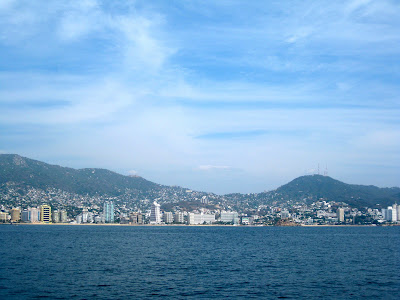
After sailing into Acapulco bay, we got a creepy feeling about the place. It was overly developed with plenty of abandoned buildings, there were all kinds of debris floating everywhere in the water (including a rotting sailfish head), and the harbor was full of dilapidated boats. The place gave us the heebie jeebies, so we turned around and headed south for Huatulco.


Sunday, January 23, 2011

Barra de Navidad, Ixtapa/Zihuatanejo, Troncones & Saladita

We left La Cruz and sailed south across Banderas Bay, heading for Barra de Navidad. The trip was uneventful except for a pod of three whales that crossed our path. The most forward one spouted of our starboard beam and it was LOUD! It was so close I could have sworn its head was under our stern.

Two days later we arrived in Barra de Navidad, a charming little town alive and bustling with beach-goers. The marina is part of a beautiful five star resort with pools, tennis courts, and yoga on the beach every day.


The town is separated from the resort by the narrow mouth of a large placid lagoon, so going to town necessitates the service of a water taxi. Just call them up on VHF 22: “Taxi Aquatico, Taxi Aquatico, this is El Tiburon,” and a panga will pick you up in ten minutes. And you can’t beat the price: ten pesos per person each way.

Water taxi dock in Barra de Navidad

The French Baker can be reached on VHF 23 and he’ll come to your boat to deliver fresh buttery croissants and crunchy baguettes. Be sure to let him know in advance if you want a ham and cheese croissant with béchamel, as they sell out first. What service!


We rang in the new year with our friends Maja, Laurent, and John from Windsong in a biker bar in town and watched the massive fireworks display.


Our next stop was Ixtapa and Zihuatanejo. We stayed in the marina in Ixtapa and it was unremarkable except for the large crocodile I saw swimming along serenely next to the dock. Kitty was kept on a very short leash after that and we walked only in the middle of the dock.

Sadly, Andrew had to fly home for a conference and his flight was out of Acapulco. We rented a car and prepared for a three-hour drive south. It turned out to be a five-hour drive on a rural two-lane highway, with vicious speed bumps at every little pueblo and dirt dappled children who stood on the speed bumps selling candies or bags of peanuts.

Eventually we got to Acapulco but had to drive through the sprawling crowded city to get to the airport on the other side and of course, we didn’t know how to get there. Waiting at a stoplight, we motioned to a gentleman to roll down his window and asked him how to get to the airport. He responded with a rapid string of Spanish words we could barely understand except I thought I heard him say “Sigame,” and for some reason I thought that might have meant “Follow me.” We followed him for a number of hectic blocks before we started to doubt that “sigame” meant “follow me” or that he’d even said “sigame” at all, and we attempted to make a left turn. The two of our cars were stopped in traffic at a diagonal from one another when I glanced back and saw our guide looking at me and motioning vigorously with both arms, jabbing his pointed fingers towards his steering wheel. I took that to mean he meant us to keep following him. We made an awkward three-point turn and were once again behind our kindly leader.

At this point, it was about forty minutes before Andrew’s international flight was scheduled to leave, and because he’d thought he’d be at the airport by now, he had set up an important conference call. He had to take it. Oh, and did I mention that he was also the one driving? And the car was a stick shift. As John was in the passenger seat, he assisted Andrew by alternately holding the phone next to his ear and shifting the gears, all while we were trying to follow a nimble and expeditious Mexican driver through the packed streets of Acapulco. Soon we began to see signs for the airport and were relieved to find our guide had not led us astray. Andrew wrapped us his call as we pulled into departures, now with only fifteen minutes before takeoff. He ran to check in and check his baggage (our broken propeller) and made the flight. What a feat it was!

While Andrew was gone, John, Luke, and I drove north of Zihuatanejo to a surf town called Troncones, then stayed in a comfy beachside house in Saladita where the waves were perfect. That night we had a massive feast of roadside chicken and beef tacos for a total of six dollars. I woke up in the morning to find this guy staring at me right outside my window: